

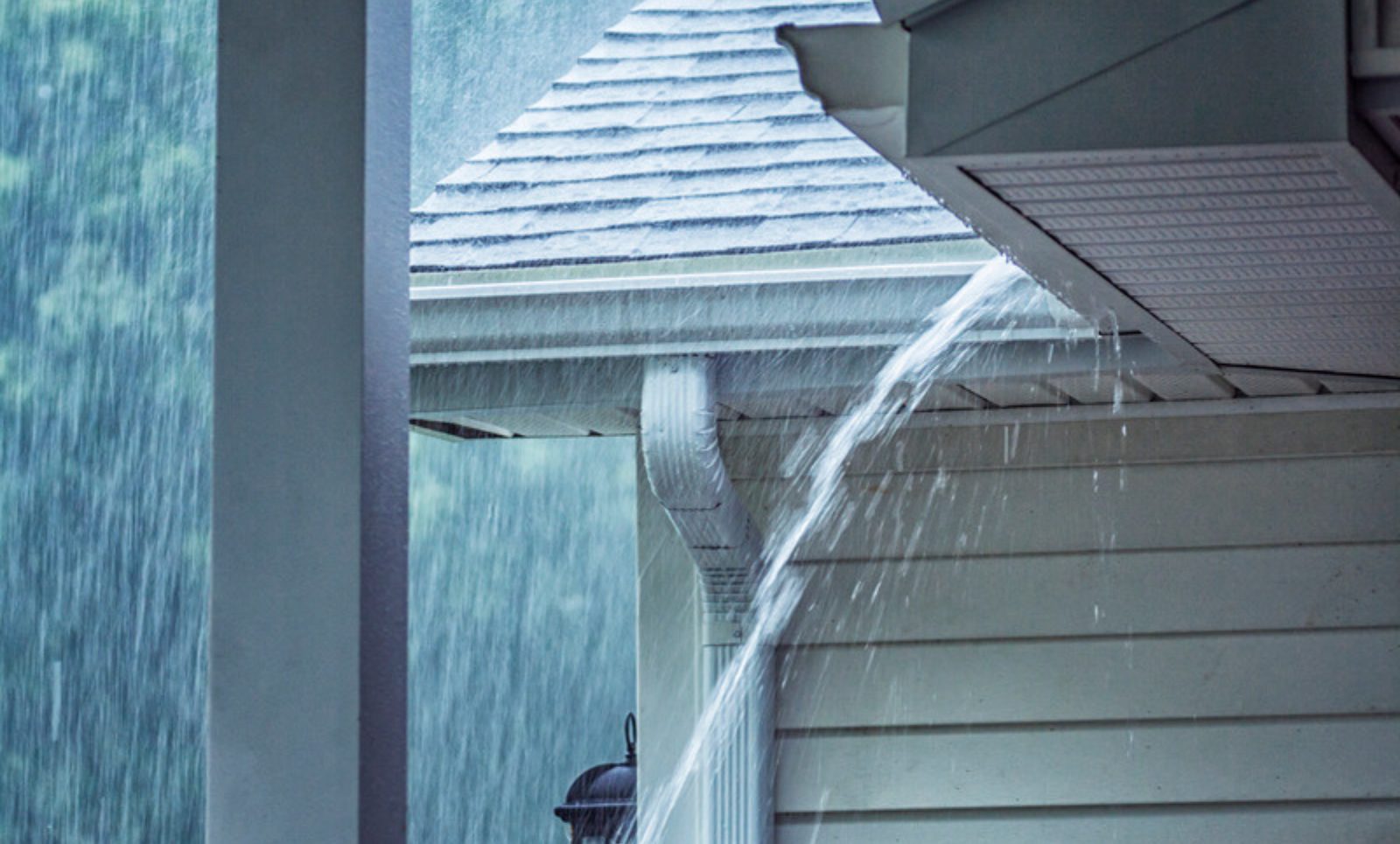
Overflowing gutters in heavy rain come down to three main reasons: they’re clogged, they’re too small for the roof, or they’re not pitched (sloped) properly. Any one of these sends roof water over the edge and down beside your foundation. The fix is usually a cleaning, a re-pitch, bigger downspouts, and sometimes a new, properly sized system.
Snow and ice get most of the attention in Northeast Tennessee. However, heavy rain is the bigger everyday risk. Every summer thunderstorm and soaking spring rain the National Weather Service in Morristown tracks across the region puts a lot of water on your roof fast, and it has to go somewhere.
Why Overflowing Gutters Happen in Heavy Rain
Clogged Gutters and Downspouts
This is the most common cause in the Tri-Cities, because oaks, maples and tulip poplars shed leaves, seeds and twigs most of the year. As a result, a gutter that drains fine in a light shower can’t keep up in a downpour when the outlet is half blocked, so water backs up and spills over the front edge. In many cases, the clog hides in a downspout elbow, where you can’t see it from the ground.
Gutters That Are Too Small for the Roof
Steep roofs, large roof sections and valleys where two slopes meet all funnel water into one stretch of gutter. So if the gutter or downspout is undersized, it overflows in a hard rain even when it’s perfectly clean. Valleys and inside corners show it first.
Sagging or Poorly Pitched Gutters
In general, gutters need a slight slope toward the downspout. When hangers loosen or the fascia behind them softens, a run sags, water pools in the low spot and the gutter overflows there. In turn, the extra weight makes the sag worse over time.
Signs Your Gutters Are Overflowing
You don’t need to stand outside in a storm to know. Look for:
- Water spilling over the front edge. Sheets of water pouring over the lip instead of running to the downspout.
- Washed-out mulch beds. A trench or a bare line in the mulch under the eaves means water is falling straight off the roof edge.
- Stains on siding or brick. Dark streaks, dirty drip lines or peeling paint just below the gutter point to water running over or behind it.
- Damp crawl spaces or basements. Musty smells, standing water or white, chalky deposits on block walls after a rain often trace back to the gutters.
- Soft or stained fascia boards. Water getting behind the gutter rots the wood it’s attached to.
- Splash marks and erosion at the foundation. Mud splashed up the wall or soil washed away near the downspouts means water is landing where it shouldn’t.
What Overflowing Gutters Can Do to Your Home
Water damage from gutters builds slowly. As a result, homeowners in Kingsport, Bristol and Johnson City often notice it only after it reaches the inside of the house. Water pooling at the foundation keeps crawl spaces and basements damp, which invites mold and rot in the floor framing, and saturated soil can push on foundation walls until they crack. In addition, overflow running down the wall stains siding, rots fascia and soffits and can work behind windows and doors. Walkways and patios near the downspouts wash out or settle. It happens one heavy rain at a time, which is why catching overflow early matters.
How to Fix Overflowing Gutters
Keep Gutters Clean and Flowing
Start here. A professional gutter cleaning clears the troughs, flushes the downspouts and checks that water runs freely to every outlet. Our maintenance program puts cleanings on a schedule so you don’t have to remember.
Re-Pitch and Re-Secure Sagging Gutters
First, we re-hang a run that has dropped at the right slope with secure hangers. If the fascia behind it has rotted, we replace that wood first.
Add Larger or Additional Downspouts
Also, when a gutter overflows even after a cleaning, the downspouts are often the problem. Larger downspouts, or an added one where a long run or valley sends too much water to a single outlet, move water off the roof faster.
Carry Water Away From the Foundation
Good downspout drainage in Tennessee means getting water well away from the house, not just to the ground. Extensions carry roof water out to soil that slopes away from your home. On hillside lots, direction matters as much as distance: send water downhill and away from the crawl space or basement, never back toward the foundation.
Upgrade to a Properly Sized Seamless System
If your gutters are old, leak at the seams or are too small for your roof, replacement is the long-term fix. Seamless gutters are what we form on site in Johnson City and across the region, one continuous piece per run, so there are no joints to leak or pull apart. The right gutter size, with downspouts placed where the water collects, keeps a system from overflowing in a downpour.
Consider Gutter Guards
A quality gutter guard keeps leaves and other debris out of the gutter, preventing it from clogging while allowing water to freely flow into the gutter and be carried away from your home.
Gutter Help Across the Tri-Cities
The Brothers That Just Do Gutters Tri-Cities is owned by Chad and Amanda Rowland, who live in Johnson City and whom Johnson City Press readers named Best of the Best Gutter Company. Our Solutionists work with homeowners in Johnson City, Kingsport, Bristol, Elizabethton, Jonesborough, Greeneville, Erwin, Bluff City, Piney Flats and Rogersville, along with Bristol, VA and Abingdon, VA.
FAQs: Overflowing Gutters
The gutters or downspouts are likely too small for the amount of water coming off that part of the roof, or a run is sagging and holding water. Roof valleys and long runs that feed a single downspout are the usual trouble spots. Larger or additional downspouts, a re-pitch or a properly sized gutter usually solves it.
Yes. Water that spills over the gutters or drains right beside the house soaks into the soil at the foundation. On sloped lots it often ends up in the crawl space or against the basement walls. Clean gutters, sound downspouts and extensions that carry water away from the house are the first line of defense.
Far enough that the water lands on ground that slopes away from your foundation and doesn’t run back toward it. On flat lots that’s a matter of distance. On hillside lots, direction matters just as much. A gutter specialist can look at your grading and recommend where each downspout should empty.
Many overflow problems are fixed with a cleaning, a re-pitch, new hangers or added downspouts. Replacement makes sense when the gutters are undersized for the roof, leak at several seams or keep sagging because the system is worn out. A seamless system sized for your roof is the long-term answer in those cases.
Get Ahead of the Next Heavy Rain
Our trained Solutionists evaluate your current gutter system, determine any problem areas, and work with you to find a solution that will eliminate your water problems. Give us a call today and our team will be happy to schedule an appointment for a free estimate. Our local office number is (423) 218-3033.
Request your free estimate online or call (423) 218-3033.